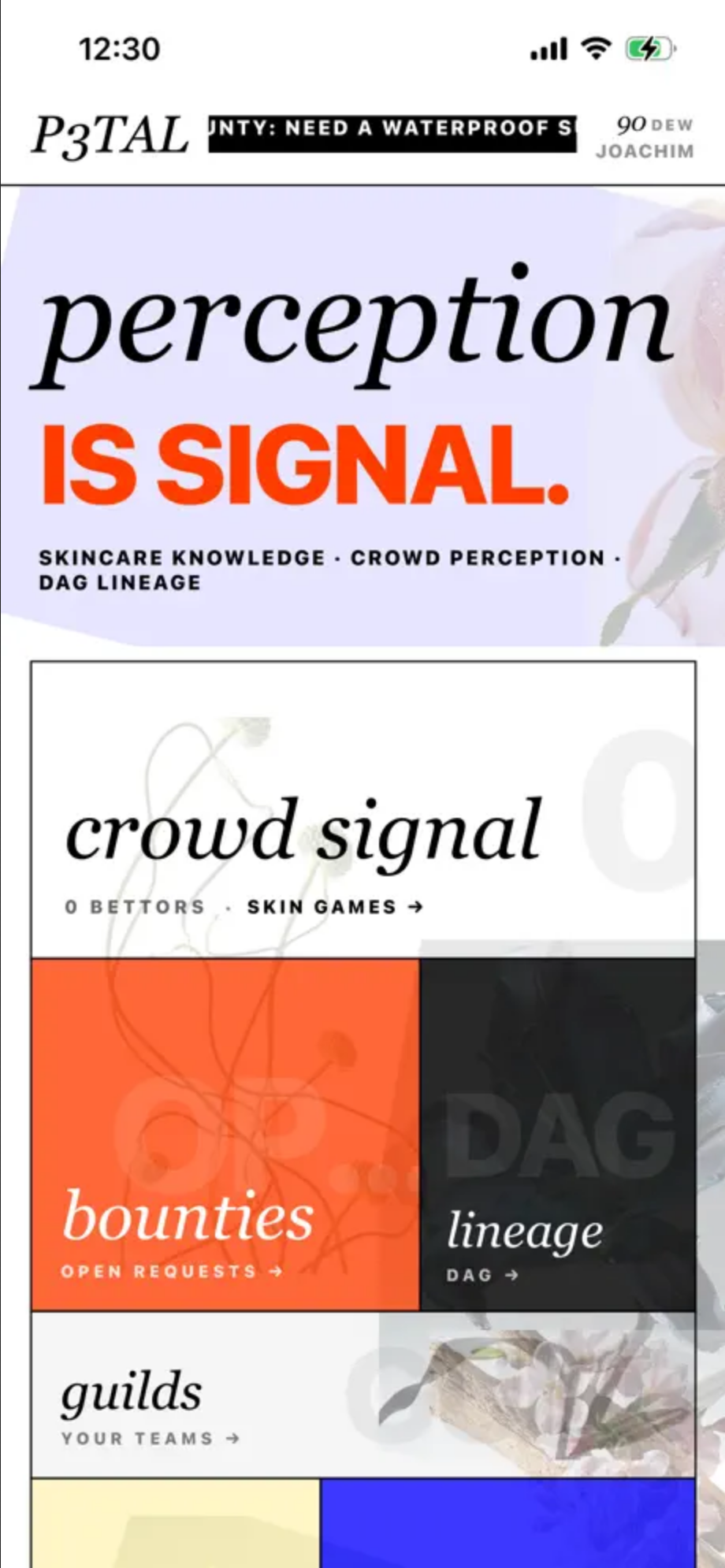
A skincare knowledge community where routines are represented as directed graphs. Users map their journey as connected nodes (products, ingredients, reactions, discoveries) with edges that encode causality: this replaced that, this caused a reaction, this complements that. The graph captures dead ends alongside successes, making the full history of a routine visible and forkable.
The design problem: skincare is flooded with paid endorsements and algorithmic recommendations that optimize for engagement, not outcomes. How do you get honest signal from strangers in a domain where everyone is selling something?
Three protocol decisions:
Perception as measurement. Users upload photo galleries across a treatment cycle. The community votes on visible change along constrained dimensions (texture, evenness, appearance). No star ratings. No aggregate scores. Perception is harder to fake than a written review and more informative than a number. The protocol produces signal by restricting what can be expressed.
Visible reasoning. Bounty respondents must attach their knowledge graph showing the path to their recommendation. You see the why, not just the what. The cost of fabricating a credible graph exceeds the cost of writing a fake review. Accountability is structural, not moderated.
Reputation from contribution, not audience. Community currency (dew) accrues from curating routines, voting on galleries, and solving bounties. Reputation reflects knowledge quality, not follower count. The protocol separates expertise from influence.
What this demonstrates: incentive architecture for a trust-dependent domain. The knowledge graph is the data structure. The perception votes are the measurement protocol. The bounties are the elicitation mechanism. The visible reasoning requirement is the accountability constraint. Each choice solves a specific incentive problem: how do you get strangers to give each other honest advice when the default is promotion?
.