Loyalty Is Not a Points Program
In 2024, Nolen Royalty built a website with a million checkboxes. One page. One million boxes. Anyone visiting the site saw the same grid. You could tick or un-tick any box. There was no chat, no profiles, no messaging. And yet people found each other.
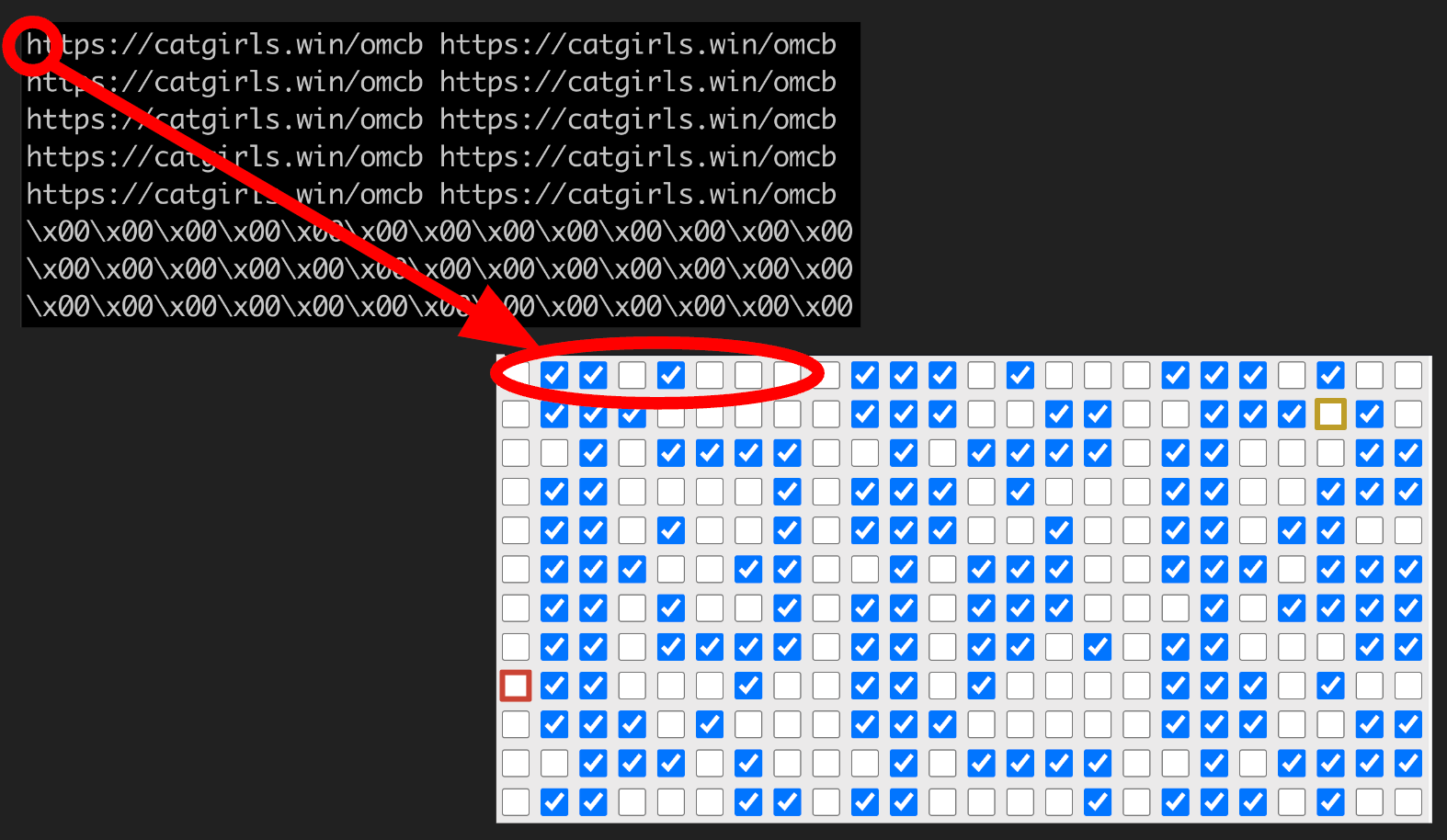
For no real reason, one day Royalty dumped the raw data as ASCII encoding. However, the bits (0 for unchecked, 1 for checked) could be read as text, and when he looked, he found a web address encoded in the checkboxes. Someone had written a message in binary using bots, and every time Royalty unchecked the boxes they would immediately get switched back. The message was persistent. It led to a Discord server.
On the server he found a group of young people who had discovered each other through the checkbox grid. They had been busy. "Have you seen your checkboxes as a 1000x1000 image yet?" They had been drawing images and encoding QR codes in the grid to find others who thought the way they did about this strange, minimal game.
No social features. No communication channel. No designed interaction beyond tick and un-tick. And humans built a community on top of it. They encoded messages hoping that someone else thinking like them would find the signal.
When given a shared space with enough structure to act in and enough freedom to surprise each other, people cooperate.
Now think how many truly shared spaces exist in the digital domain. How many interactions with a brand or platform are actually based on connection? How many of you are "loyal" to Amazon? You like the convenience, you like the prices. But beyond that? Shopping malls were places to hang out. They were of course commerce-driven machines, but as a side benefit they created a sense of community and connection. Is it possible to re-imagine that for the current age? Can we create attachment via community?
The isolation problem
Most loyalty programs are designed to create lock-in. You accumulate points. Points convert to discounts. If you leave, you lose your points. The implicit logic is: we will make leaving expensive so that you stay.
If a million checkboxes with zero social features can produce spontaneous community, what does it say about a loyalty program that produces zero community despite having a captive audience of paying customers who already share an interest?
It says the program was designed for isolation. The program generates transactions, not relationships. My loyalty is exactly as strong as the value of my account balance. The moment a competitor offers a better deal, the rational move is to leave. The program created a purely transactional relationship and is surprised when the customer behaves transactionally.
The deeper problem is that lock-in is not loyalty. Lock-in is a cage. Loyalty is a relationship where both sides have reasons to continue.
The question is: can a loyalty program create trust rather than lock-in? Can it give people a shared surface rich enough that they weave themselves together the way those kids did with a million checkboxes?
What if loyalty is not to the points but to the people in the system?
Resilience in cohesion
Why weave people together? Because a community where members know each other is a community that defends itself.
Connection creates cohesion. Cohesion creates resilience. When your customers are invested in each other, they become invested in the ecosystem. They have eyes on the street. They notice when something is wrong. They resist extraction because extraction degrades something they personally value.
Your moderation costs go down because the community moderates itself. Your retention goes up because leaving means losing relationships, not points. And your signal quality improves because people making real choices about real commitments generate data that no amount of click-tracking can replicate.
A community of isolated points-collectors is defenseless against bad actors. Nobody knows anyone. Nobody has reason to care about the health of the system. A community of interconnected members with social standing, shared history, and visible reputation is a different organism entirely and it can be self-healing.
The community can solve your platform problems
Every problem a platform faces can be re-framed as an opportunity for community-driven solutions. Consider recommendations.
Right now I can search, read blogs, watch YouTube reviews, or consult Reddit. But what if the ecosystem itself provided the place for these recommendations? Not algorithmic recommendations. Human ones. From people who share a connection to the brand and want to help others find the right match.
Take Glossier. The brand was built on a blog. It started as a community of readers who found each other through shared taste. It felt like a secret. Then it pivoted to a standard retail experience and became a brand like any other.
When I visit the skincare section today, I see a grid of products.

The usual shopping grid
This is a shopping page like any other. I am left to my own devices to figure out what would work for me. There is no trace of the community that built this brand. There is no way to consult other members. There is no shared surface.
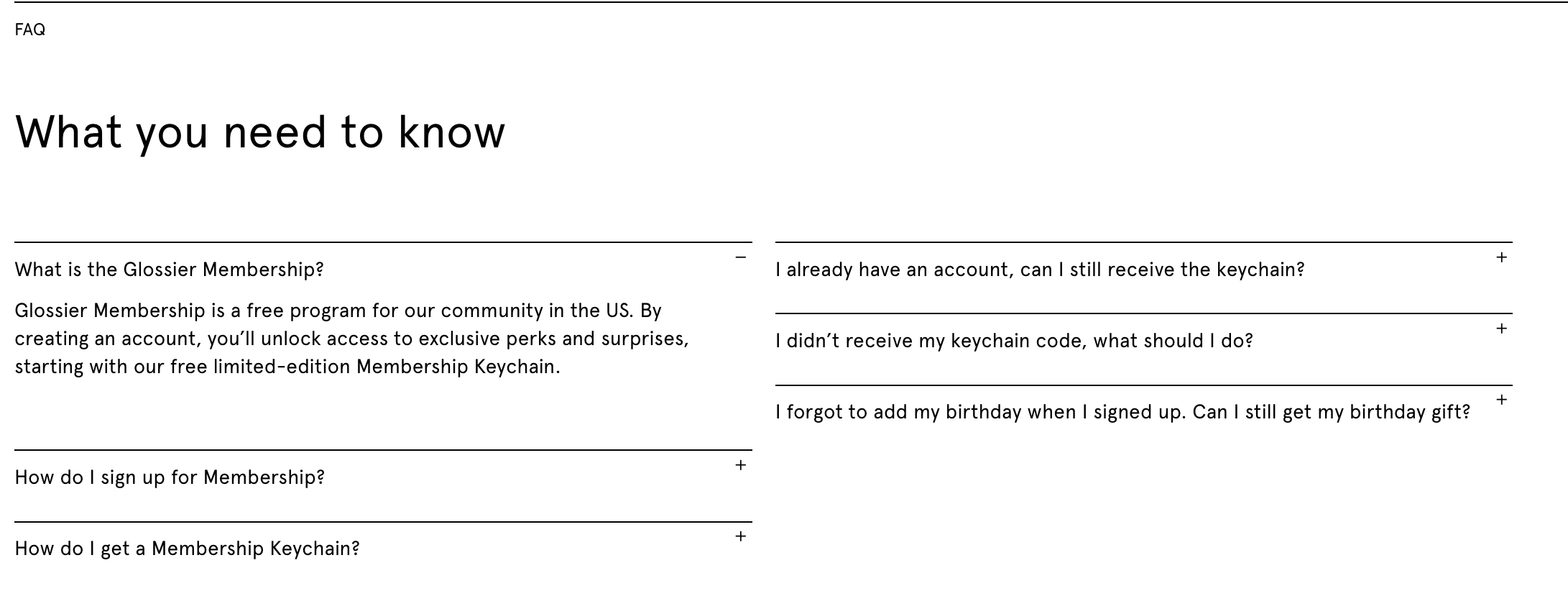
Glossier does have a loyalty program, but it is nowhere to be found on the homepage. When you do eventually find it, you see this explanation of the benefits:
Keychain!
The FAQ mentions a free keychain in four of the six questions. A keychain. This is what Glossier believes membership is built on. And then there are unnamed perks and surprises.
So what could be done? Let us return to the question of shopping on Glossier. What if I could request help from other members? What if I could post a quest asking the community for a skincare recommendation tailored to my situation? What if someone with demonstrated expertise and standing in the community could respond, and earn social recognition for providing genuinely useful guidance?
The immediate problem is obvious: how do you ensure the recommendation is good? How do you prevent spam, self-promotion, or lazy responses? You need skin in the game.
This is where social currency becomes key. If a member responds to a quest and provides a recommendation, they can earn social standing. But to make the recommendation credible, they have to stake some of their existing standing on it. This is a variation on the lockbox protocol. If the recommendation is helpful (verified by the requester, or by outcomes the platform can observe), the responder earns back their stake plus a bonus. If it is low effort or unhelpful, they lose what they staked.
Now the incentives are aligned. Contributing to the community is rewarded. Contributing badly is costly. And the community generates a recommendation layer that no algorithm could replicate, because it is built on human judgment with real accountability attached.
Two kinds of standing
This architecture runs on a distinction between two types of earned standing. Solo standing is earned through individual engagement: purchases, time spent, activities completed. It is the equivalent of points in a traditional program. It measures how invested someone is in the platform's offerings.
Social standing is earned through contribution to others. Peer recognition, collaborative activity, useful recommendations, participation in community quests. Social standing is not awarded by the platform. It is earned from other members, through interactions where commitment is credible and follow-through is verifiable.
The two types serve different purposes. Solo standing keeps individuals engaged. Social standing weaves them together. A platform with only solo standing is a points program. A platform with both is a social infrastructure.
Social standing should be the focus. It should carry greater weight in unlocking perks. It should be what the community sees first when encountering another member. Because social standing is the signal that cannot be faked at scale: it represents the accumulated judgment of your peers, not the accumulated history of your spending.
Making commitment credible
Social standing only works if it is costly to earn and costly to give away.
Peer recognition works when members send standing to each other from their own balance. Your balance decreases. The recipient's social standing increases. This is not a free "like." It is a transfer with a real cost, which makes the signal honest.
Collaborative activity works when participants commit social standing in escrow before the activity begins. If the group completes the objective, the escrow is returned as social standing plus a bonus. If a participant abandons the group, they lose the escrowed amount. The escrow makes commitment credible. The bounded loss makes participation rational even between strangers. And the completed activity becomes a verifiable credential that nobody had to rate or review.
Of course, the details matter. The size of the escrow, the conditions for its return, the verification mechanism, the secondary markets for standing, the seasonal resets, the interaction between social standing and solo standing. Each of these is a design decision with consequences for what the system rewards and what it discourages. Getting them wrong produces a loyalty program that either fails to create genuine community or creates one that consolidates power among early adopters and excludes newcomers.
Trust is not the input to this process. It is the output. This is the same principle that drives the lockbox protocol: structure the interaction so that cooperation is rational at zero trust, and let trust emerge from repeated follow-through. The mechanism creates the conditions for trust to emerge from structure rather than from faith.
Not everyone wants this
Maybe your customers just want discounts and perks and do not care about expanding their connections. There are plenty of systems that do exactly that.
Self-selection out of the social layer is a feature, not a bug. The program is for people who want more than a discount. The ones who don't will use a standard points system. But for the members who do want more, who are looking for something beyond a transactional relationship with a platform, this architecture creates a space where cooperation is possible, where trust is built through structure, and where loyalty emerges from genuine attachment rather than artificial lock-in.
That is why interweaving customers is not a bolt-on to an existing loyalty program. It is a design challenge. Most platforms do not have anyone thinking at this layer. The data science team is optimizing conversion on the points system. The product team is iterating on the app. Nobody is asking whether the system's underlying logic of interaction is producing the relationships the business actually needs.
The people on the checkbox website did not need anyone to tell them to cooperate. They needed a shared surface. The loyalty program's job is to be that surface. If you are running a platform and your loyalty program is still a points system, you are leaving your customers in isolation while hoping their account balances are enough to keep them from leaving.
Ansible Architecture designs incentive systems and interaction protocols for platforms and marketplaces.